How to Beat the AI Proctor: Mastering a "Human" Rhythm for High CCAT Scores
Fair warning up front: leaning on an LLM mid-test usually backfires. The clock produces timed-out questions and the telemetry produces unnatural patterns, and both get flagged.
Modern CCAT assessments do not only score what you answer. They watch how you move through the test as closely as they watch whether you picked B or C, layering behavioral telemetry and AI proctoring on top of the question score. That can feel invasive, especially when video proctoring is checking for physical cheating like a second device photographing the screen for ChatGPT. But once you understand what the system is measuring, you can behave like what you are, a sharp human under pressure, and still get the competitive score you deserve.
This is not about “tricking” a fair exam. It is about avoiding false positives by not cheating. Fast spatial prep can make you look inhuman if you ignore timing and environment. Finish strong, stay inside a believable rhythm, and keep tab focus clean so nobody has to second-guess your session.
How AI Proctoring Actually Works
Most proctoring stacks combine browser signals with statistical scoring: tab visibility, focus loss, paste attempts, suspicious right-click behavior, and leaving the assessment surface for calculators, notes, or search. The analytics layer also scores cadence, meaning dwell time before selection, unnaturally uniform timings, and ultra-fast answers on items that usually slow people down.
Across a section, that becomes a behavioral profile. Too-perfect pacing or lightning answers on visually heavy items can flag you even when you are fully correct. The model is not reading your mind; it is asking whether your clicks look human or automated.
Think of it as two scores: correctness and plausibility. You want both.
The Spatial Reasoning Trap
Spatial reasoning is where “fast prep” collides with suspicious telemetry. Pattern items reward rapid visual parsing, but a prepared test-taker can lock the rule in seconds while the median candidate takes longer, and models notice that gap on hard visuals.
The items below are the kind that trigger reviews when answered too quickly, even when you are legitimately strong at rotations, alternation, and grid constraints.
Spatial Reasoning Tips (With Real Structure)
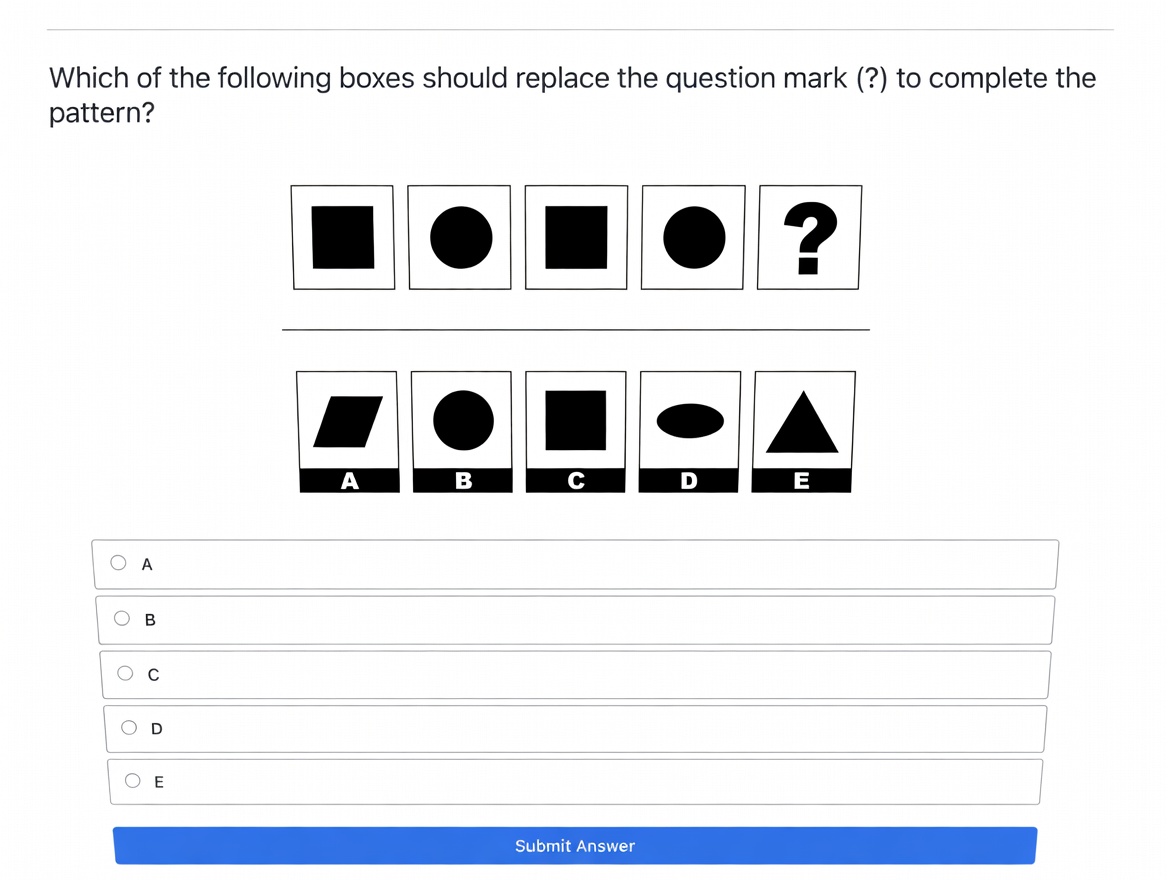
Shape sequence
Read the sequence on two tracks: alternation (square, circle, square, circle) and size progression (large shapes shrinking rightward). When both lock, the next cell is forced. Here, alternation calls for a square and the size line still fits a square, so the answer is C (square).
Arrow rotation
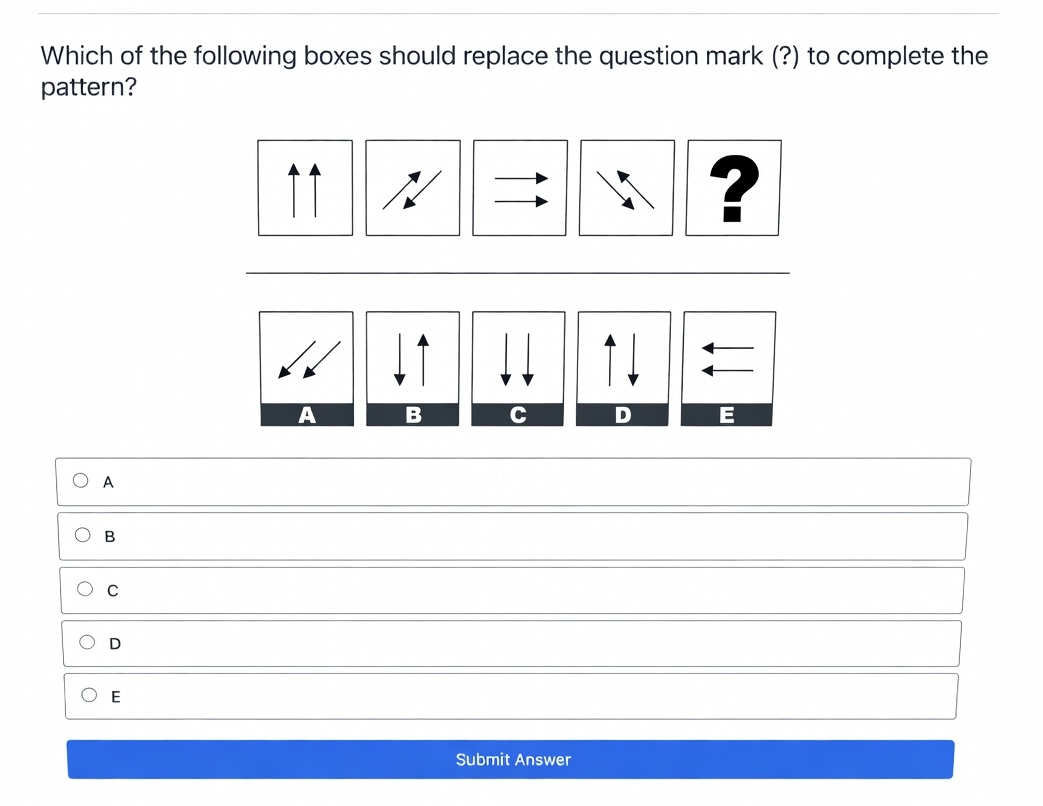
The pattern follows a simple clockwise rotation of 45 degrees in each step:
- Box 1: Vertical (pointing up).
- Box 2: Diagonal (up and to the right).
- Box 3: Horizontal (pointing right).
- Box 4: Diagonal (down and to the right).
- Target Box (?): Another 45-degree clockwise turn results in the arrows pointing straight down.
This makes Option C the only one that completes the sequence correctly.
Why this works: The cognitive principles behind the question
The question follows the “Next in Series” format, which is a staple of abstract reasoning tests. It relies on three key psychometric and cognitive principles to measure your problem-solving speed:
1. Rule-Based Progression (Isomorphism)
The core principle is that the relationship between any two consecutive frames must be identical to the relationship between the next two. In this case, the rule is a constant +45° clockwise rotation.
- Box 1 to 2: +45°
- Box 2 to 3: +45°
- Box 3 to 4: +45°
The Principle: If the logic holds for the first three transitions, it is “locked” as the rule for the final answer.
2. Single Variable Transformation
High-speed tests like the CCAT often use “Single Variable” logic for their mid-tier questions.
- What stays the same: The number of arrows (2), the shape (parallel straight lines), and the position (centered).
- What changes: Only the orientation.
The Principle: By keeping other variables static, the test measures your Mental Rotation speed: how quickly your brain can “render” the next physical state of an object without getting distracted by changing colors or counts.
3. Inductive Reasoning
This is the “detective work” of cognitive testing. You are provided with a limited data set (4 boxes) and asked to derive a universal law.
The Principle: You aren’t being tested on “math” or “facts,” but on your ability to synthesize a pattern from chaos. In a data engineering context, this is the same mental muscle used to identify data anomalies or schema patterns.
Grid logic
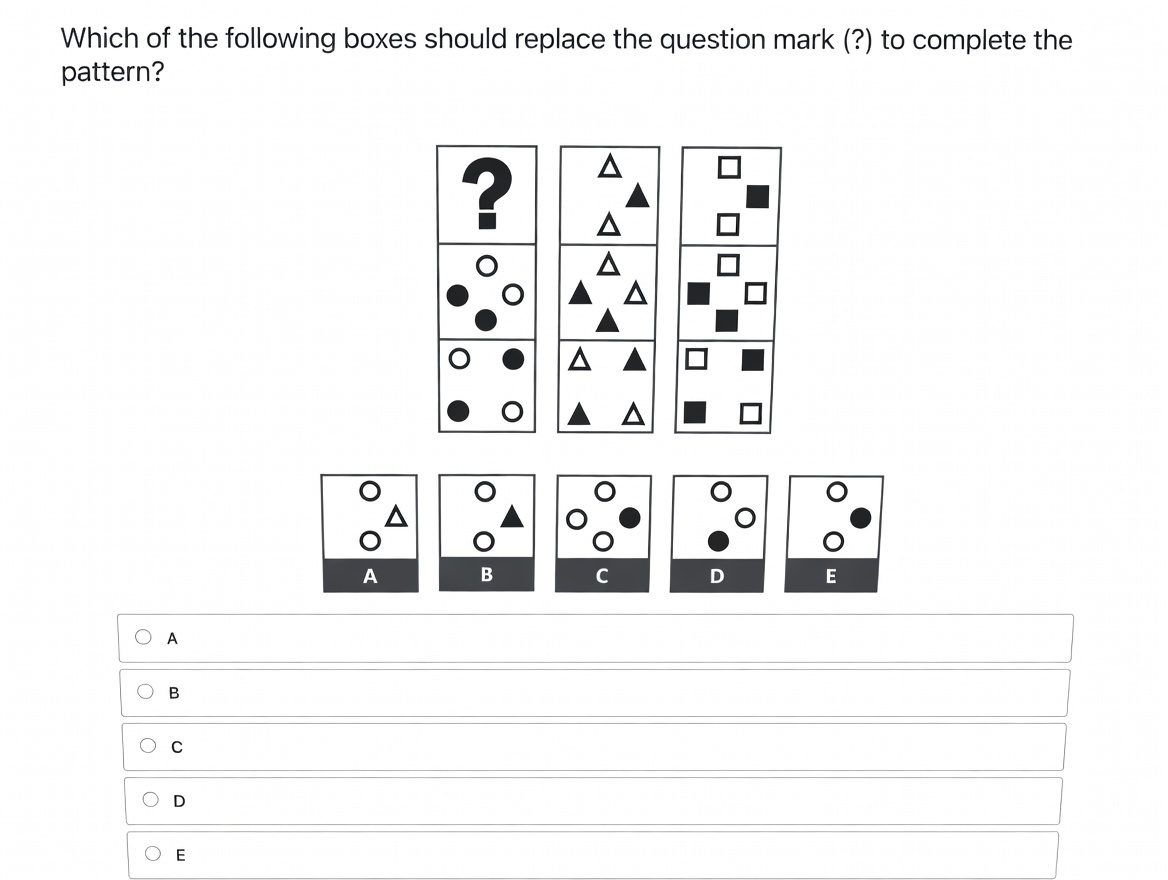
This is a Matrix Reasoning puzzle that uses Columnar Isomorphism. The rules governing the second and third columns are identical, and the missing cell in the first column must follow the same template.
- The Shape Rule: Each column uses one shape family: Column 1 is circles, Column 2 is triangles, Column 3 is squares. This immediately eliminates Options A and B, which contain triangles in the circles column.
- The Count Rule: In Row 1, the top-center cell (triangles) has exactly 3 shapes, and the top-right cell (squares) also has exactly 3 shapes. The missing cell must have 3 circles. This eliminates Options C and D, which each contain 4 shapes.
- The Shading Rule: In both the triangle and square Row 1 cells, the layout is the same: 2 outlined shapes and 1 filled shape, with the filled shape on the right. The missing cell must have 2 outlined circles and 1 filled circle, with the filled circle on the right.
Option E is the only match: exactly 3 circles (2 outlined, 1 filled) with the filled circle on the right, mirroring the pattern established by the other two columns.
The meta-skill is identical across all three: name the rule in one sentence before you touch an answer. If you cannot name it, you are guessing, and guessing fast is the worst of both worlds.
The “Human Rhythm” Strategy
Even when recognition is instant, do not click instantaneously. Use a four- to eight-second confirmation window on items you already know: restate the rule, verify the key transform, and let timing jitter instead of snapping to a robotic beat.
Treat spatial visuals strictly: under two seconds reads like automation. Stay off that tail. Budget fifteen to twenty seconds on medium items. On hard or noisy visuals, bail after about twenty seconds. Flag and move. The CCAT rewards completion as much as accuracy.
Vary your pace section-to-section. Micro-variation beats consistency. Organic tests look a little messy, in a controlled way.
Integrity Best Practices That Also Protect Your Score
Stay on the exam tab, close unrelated windows first, and treat the browser like a locked room. Skip right-click menus, copy-paste shortcuts, and extra tabs. Even one counts. Use the on-screen tools instead of a separate calculator app. Mark for review in-app rather than notes elsewhere, because every focus hop can show up in telemetry.
Silence notifications, chat, and overlays before you start. Interruptions are logged focus-loss events, not mere annoyances. Modern tests also use video proctoring to catch physical cheating, such as a second device photographing the screen for an LLM. In practice the 18-second per-question pace is its own defense: by the time a candidate captures an image, uploads it, and waits for an AI to analyze the logic and return an answer, most of the window is already gone. That is why the LLM route reliably produces timed-out questions and the unnatural patterns the scoring analytics exist to catch.
For a deeper dive on live-proctored testing (webcams, phone cameras, screen sharing, environment checks) and how the proctored CCAT (PCCAT) compares to standard browser-based monitoring, see What Is the Proctored CCAT (PCCAT)?
Why TestCCAT Fits This Prep Model
TestCCAT's practice exams run the same class of integrity monitoring described above: focus tracking, timing analysis, and a post-session audit. Practice under realistic conditions so nothing about the telemetry surprises you on test day.