The Ultimate CCAT Math Cheat Sheet: Mental Shortcuts for 18-Second Success
See where your mental math stands first. The Algebra drill is free: 5 questions, 90 seconds, no signup required. Run it, then read this cheat sheet with your weak spots in mind.
Start the free Algebra drill →The CCAT gives you roughly eighteen seconds per question. That is not a lot of room to hesitate. Math items tend to spike anxiety the fastest because they look like “real work” on the clock: fractions, rates, and multi-step word problems stacked in a row. This cheat sheet is built for one job: give you mental shortcuts you can actually use under pressure so you spend less time calculating and more time moving.
You do not need cleverness. You need a small set of reliable moves you can deploy before your brain starts narrating doom. The examples below are written the way the test writes them: plain language, numbers that cancel if you set the problem up cleanly, and answers that should feel obvious once you see the structure.
Real Example: The Recipe Question
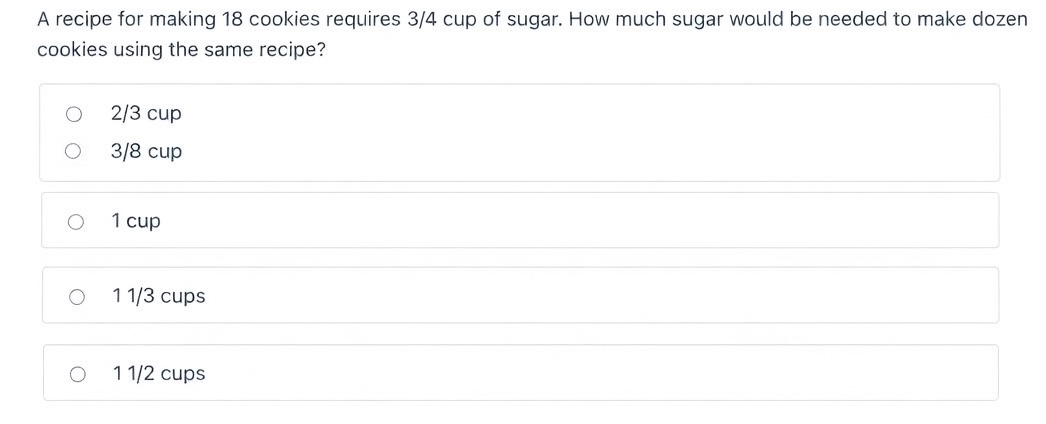
Here is a classic ratio setup: “A recipe for making 18 cookies requires 3/4 cup of sugar. How much sugar would be needed to make two dozen cookies using the same recipe?”
Two dozen is 24 cookies, not 18. Lock that first. You are scaling from 18 to 24, so the multiplier is 24/18, which reduces cleanly to 4/3. Multiply the original sugar amount: 3/4 × 4/3 = 1. Answer: one cup.
If you hate fractions, treat the scale factor as “how many times bigger is the batch?” The batch grows by a factor of 4/3, so anything in the recipe, including sugar, scales by that same factor. That framing keeps you from inventing extra steps.
Under ten seconds in your head: write the scale-up as a single multiply with cancellation before you multiply across. Think (3/4) × (24/18). Cancel the 24 with the 18 first (both divisible by 6 → 4 on top, 3 on bottom), then notice 3/4 × 4/3 kills itself to 1. You never needed to fuss with decimals or long division.
Real Example: The Pool Work Rate Question
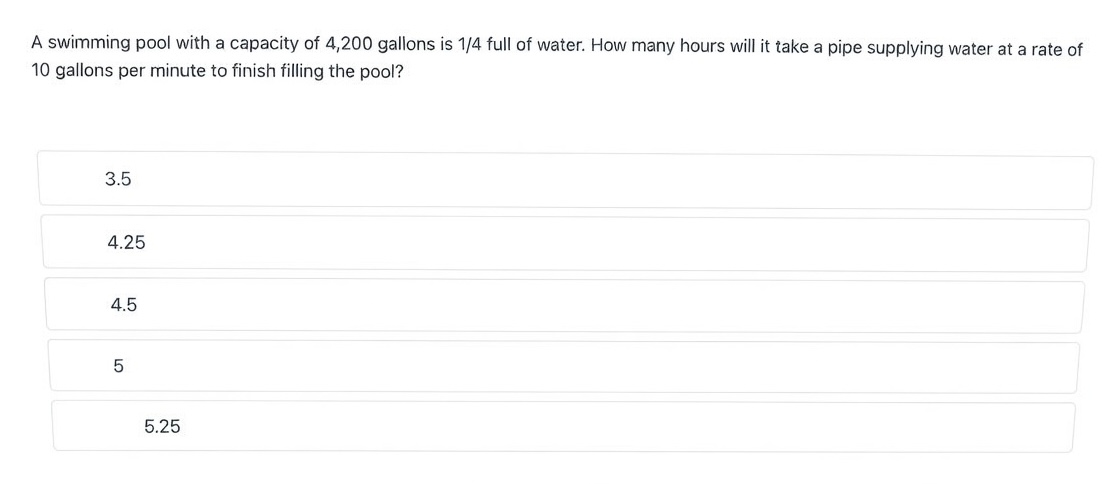
Another common shape: “A swimming pool with capacity 4,200 gallons is 1/4 full. How many hours will it take a pipe supplying 10 gallons per minute to finish filling the pool?”
If it is one-quarter full, three-quarters remain. Three-quarters of 4,200 is 3,150 gallons needed. Sanity-check it fast: half of 4,200 is 2,100, and 3,150 is halfway between 2,100 and 4,200. The pipe is 10 gallons per minute, which is 600 gallons per hour. Now you need 3,150 ÷ 600 hours.
Notice the test is handing you two separate skills: remainder volume (fraction of a whole) and rate (volume per time) with a unit switch baked in. Handle the unit switch once, then the division is just “how many 600s fit into 3,150?”
Mental decomposition trick: split the numerator into friendly pieces. 3,000 ÷ 600 = 5 and 150 ÷ 600 = 0.25, so the total time is 5.25 hours. That is faster than grinding the full long division on every digit.
Real Example: The Discount Question
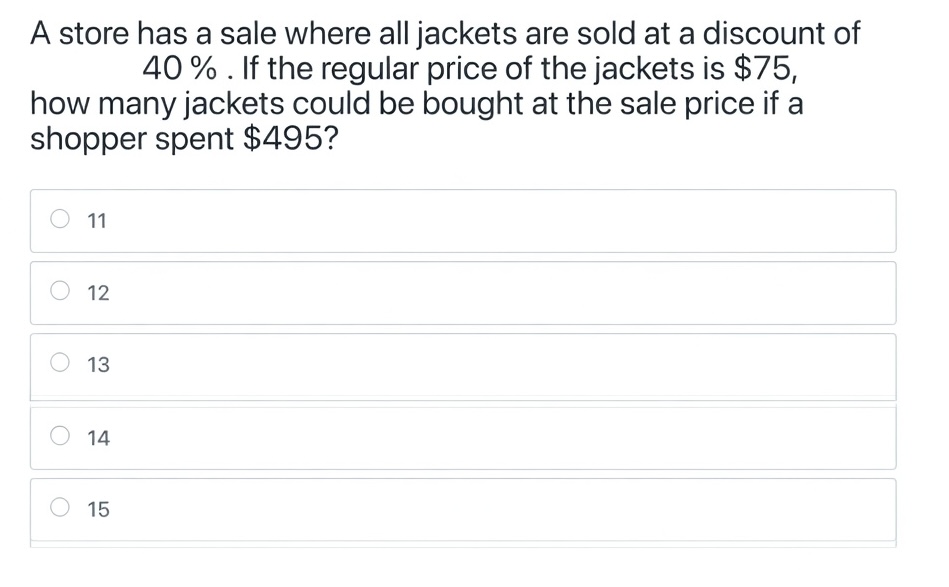
“A store has a sale where all jackets are sold at a discount of 40%. If the regular price of the jackets is $75, how many jackets could be bought at the sale price if a shopper spent $495?”
Two moves, done. First, find the sale price: 40% off means you pay 60%. $75 × 0.60 = $45. If percentages feel slow, use the anchor trick: 10% of 75 is 7.50, so 40% is 7.50 × 4 = $30 off, leaving $45.
Second, divide the budget by the sale price: $495 ÷ $45 = 11. If dividing by 45 feels awkward, notice that 45 × 10 = 450 and 495 − 450 = 45, which is exactly one more jacket. So 10 + 1 = 11.
Answer: 11. This question tests two shortcuts in sequence: the Percentage Anchor (find the discount) and the Decomposition Trick (break the division into a round number plus remainder). Under 10 seconds if you chain them.
Real Example: The Table Lookup Question
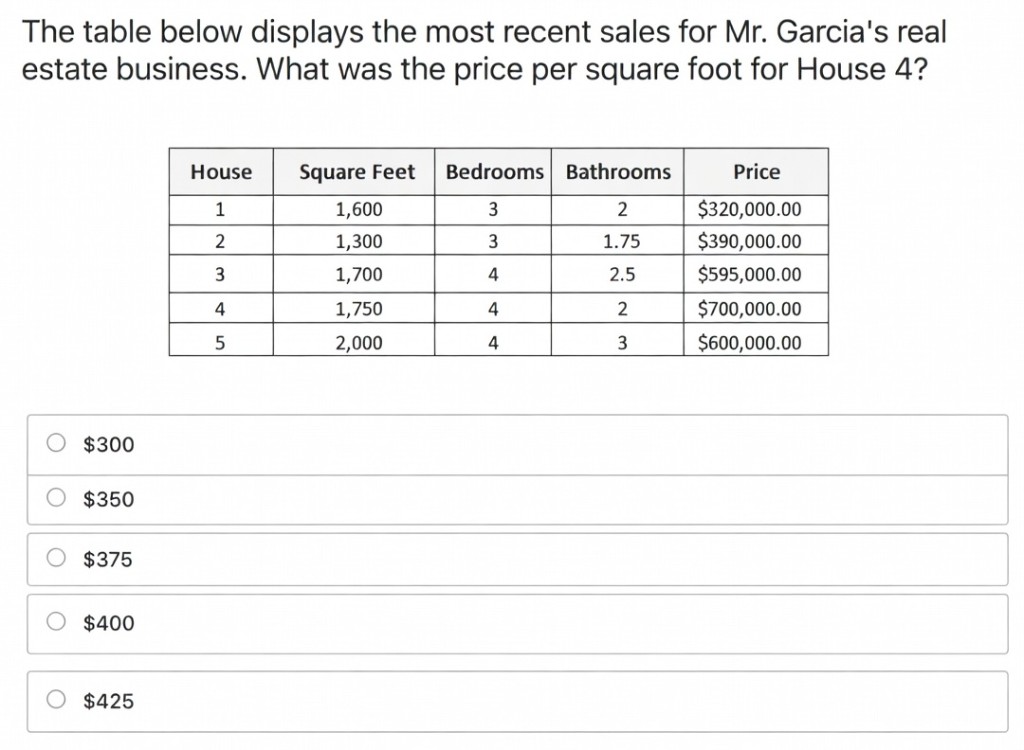
“The table below displays the most recent sales for Mr. Garcia’s real estate business. What was the price per square foot for House 4?”
Do not let the table intimidate you. Most of the data is a distraction. You only need two cells: House 4’s price ($700,000) and square footage (1,750). The formula is simply Price ÷ Square Feet.
$700,000 ÷ 1,750. Use decomposition: 700,000 ÷ 1,750 is the same as 700 ÷ 1.75 (divide both by 1,000). And 1.75 × 400 = 700, so the answer is $400.
Answer: $400. Table questions are speed gifts. The math is usually one division. The real test is whether you can ignore the irrelevant rows and columns and extract only what you need without getting distracted.
Real Example: The Combined Rate Question
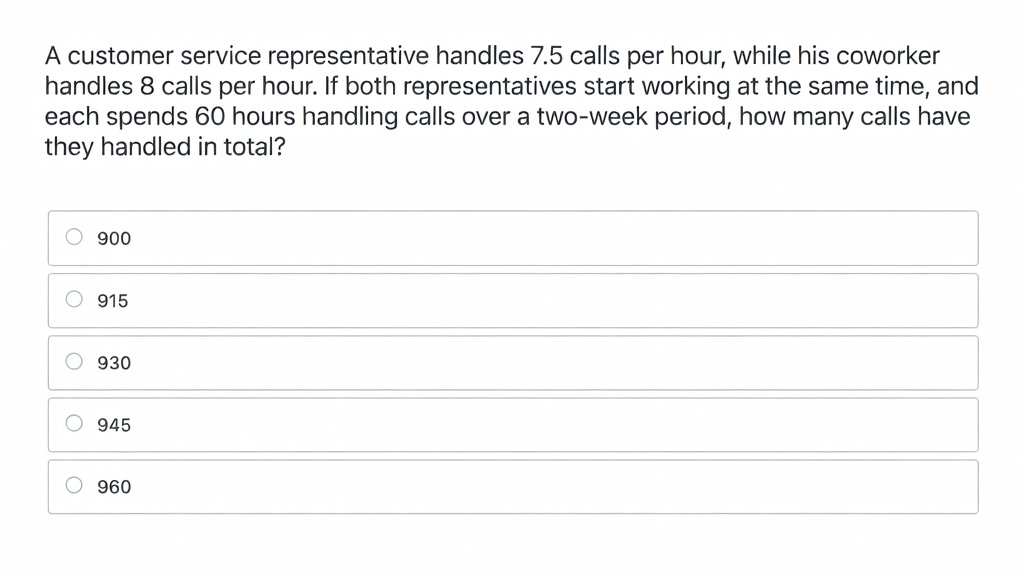
“A customer service representative handles 7.5 calls per hour, while his coworker handles 8 calls per hour. If both representatives start working at the same time, and each spends 60 hours handling calls over a two-week period, how many calls have they handled in total?”
The “two-week period” and “start at the same time” details are noise; they already told you each works 60 hours. Combine the rates first: 7.5 + 8 = 15.5 calls/hour. Then multiply by hours: 15.5 × 60.
Decompose: 15 × 60 = 900 and 0.5 × 60 = 30, so 900 + 30 = 930. Or compute each person separately: 7.5 × 60 = 450 and 8 × 60 = 480, total 450 + 480 = 930.
Answer: 930. Combined-rate questions always have the same structure: add the rates, multiply by time. The CCAT pads these with extra context (“two-week period,” “start at the same time”) to waste your clock. Strip it to rates and hours, then compute.
Cheat Sheet: 6 Mental Math Shortcuts
Keep these six moves loaded. Most CCAT math is not “advanced”; it is pattern recognition plus clean execution. When you see a problem, your first thought should be “which shortcut applies?” not “how do I re-learn algebra from scratch in fifteen seconds?”
1. The Fraction Flip
When you divide fractions, flip the divisor and multiply. It sounds basic because it is basic, and that is why it wins. Most CCAT fraction problems collapse once you stop treating division like a mystery and start flipping. If you can rewrite any messy division as a multiplication problem with cancellation, you win speed without losing accuracy.
2. The Decomposition Trick
Break big numbers into chunks your brain likes. Need a quarter of 4,200? Think 4,000/4 + 200/4, which is 1,000 + 50 = 1,050. Same answer, less mental friction. Use the same idea on division: peel off thousands, then handle the remainder, then add. It is exactly how the pool question split 3,150 into 3,000 and 150 before dividing by 600.
3. The Percentage Anchor
For percentages, anchor on 10% first, then scale. Example: 15% of 80. Ten percent is 8, five percent is half of that (4), so 8 + 4 = 12. You avoid messy multiplication and you stay accurate when you are tired. If the question throws 17.5% or 35% at you, still build from 10% and 5%. Do not reach for a calculator mindset when structure is enough.
4. The Ratio Shortcut
When you scale recipes, distances, or any proportional quantity, set up the ratio, cancel common factors, then multiply what is left. Cross-cancel before you multiply so the arithmetic stays small and fast, the way the cookie example cancels to nothing. If you see the same number on top and bottom after simplifying, you are basically done; do not multiply yourself into a harder problem.
5. The "Work Backwards" Trick
If the answer choices are numbers, plugging in can beat solving forward, especially when the algebra is messy or you are one careless sign away from a trap. Test the middle-ish option first when it makes sense; let the structure of the answers work for you. This is not cheating the test; it is using the test’s own constraints as a shortcut.
6. Unit Conversion First
Normalize units before you calculate. Minutes to hours, dozens to single items, gallons per minute to gallons per hour. Do that step once, clearly, so you are not “solving” the wrong problem faster. The pool question is a perfect example: get to gallons per hour, then divide. If your answer is off by a factor of 60, you almost always missed a unit, not a concept.
Time Management for Math
Important: The official Criteria Corp CCAT does not let you go back to previous questions. Once you submit an answer and move on, that question is locked. This makes your per-question decision critical.
If a math problem clearly needs more than three clean steps, make your best guess and move on. Your first ten seconds tell you whether a shortcut applies. If nothing clicks, eliminate what you can, pick an answer, and protect your time for the next question. Spending forty seconds on a problem you might still get wrong costs you two easier questions you would have nailed.
The CCAT punishes perfectionism more than it punishes guessing. There is no penalty for wrong answers, so a fast educated guess beats a blank or a time sink every time. Train yourself to commit and move forward. That discipline is worth more than any single math trick.
Practice these shortcuts with realistic timed exams at TestCCAT. The free practice test includes math questions built like the ones above (tight ratios, unit shifts, work-rate setups) so your shortcuts become automatic instead of theoretical.