Comparison
TestCCAT vs. JobTestPrep, 12minprep, and Official CCAT Prep: Which Should You Use?
Updated
Former Senior Software Engineer at AWS · Creator of TestCCAT
Most CCAT prep sells you more questions, more full-length tests. TestCCAT makes a different bet. That what actually moves your score is feedback and retention, not sheer quantity. Here's an honest look at how it compares to the popular alternatives like JobTestPrep, 12minprep, BoostPrep, and Criteria's own resources, and when each one is the right call.
Quick answer: which CCAT prep should you use?
Start with Criteria's official page to learn the format. If you mainly want a big pile of simulations and study material, a commercial pack like JobTestPrep fits. Choose TestCCAT if you want practice that remembers what you missed, tells you why your score moved, and keeps weak spots in rotation until they actually stick.
This comparison is based on public product pages reviewed in June 2026. Competitor features and pricing change, so treat it as a practical buyer's guide, not a permanent feature audit.
| Option | Best for | Strengths | Keep in mind |
|---|---|---|---|
| TestCCAT | Practice plus feedback that fixes weak spots | Timed exams, 650+ questions, subcategory drills, hard-clock pacing drills, score dashboard, tutor insights, spaced mistakes review, integrity-check practice | Built to diagnose and retain, not to be the biggest bank |
| JobTestPrep | A traditional commercial prep pack | Full-length simulations, focused drills, study guides, a long-running brand | Spaced retention and proctor practice aren’t its advertised focus* |
| 12minprep | A quick free sample and overview | Free sample test, format overview, a free sample with a paid course | Less focus on ongoing analytics or category drills* |
| BoostPrep | Extra full-length exam sets | Choice of 4 ($29.99 Core) or 8 ($39.99 Complete) full-length practice exams, simple test-taking flow | When we tried Core it was test-taking only: no drills, no actionable insights, no mistakes review* |
| Criteria (official) | The official word on the format | Official CCAT format: 50 questions, 15 minutes, question types, no calculator | A reference, not a practice platform |
Feature-by-feature comparison
| Feature | TestCCAT | JobTestPrep | 12minprep | BoostPrep | Criteria (official) |
|---|---|---|---|---|---|
| Full timed CCAT simulation | ✓ Free + premium | ✓ Yes | ✓ Free sample | ✓ 4-8 exam sets | — Format info |
| Free practice (no sign-up) | ✓ No sign-up | ~ Some free | ✓ Free sample | — Not advertised* | — Guidance only |
| 650+ question bank | ✓ 650+ | ✓ Large pack | ~ Some | ~ Exam sets only | — No |
| Subcategory drills | ✓ 20+ subcategories | ✓ Focused drills | — Not advertised* | — None in Core† | — No |
| Forced-skip pacing drills | ✓ Hard 18s auto-advance | — Not advertised* | — Not advertised* | — None in Core† | — No |
| Post-test score dashboard | ✓ Trend + projection | ~ Varies* | ~ Basic | ~ Score only† | — No |
| Tutor-style insights | ✓ Yes | — Not advertised* | — Not advertised* | — None in Core† | — No |
| Spaced mistakes review | ✓ Yes | — Not advertised* | — Not advertised* | — None in Core† | — No |
| Integrity-check practice | ✓ Yes | — Not advertised* | — Not advertised* | — Not advertised* | — No |
| Price | $24.99 for 12 months of access | $79 to $99 (1 week to 3 months of access) | $29 for 12 months of access | $29.99 Core (4 exams), $39.99 Complete (8 exams) | Free guidance |
* Based on each provider's public CCAT pages, reviewed June 2026; prices checked July 2026. † Based on our own purchase of BoostPrep's Core package in July 2026; the Complete tier may differ. “Not advertised” means the feature wasn't a stated focus on those pages, not that the provider couldn't offer something similar. ✓ = clearly offered, ~ = partial or varies, — = not offered or not applicable.
How to read this
Criteria's own candidate page is the best source for the official basics: the CCAT has 50 questions, a 15-minute time limit, verbal/math/spatial question types, and no calculator. Criteria also notes that fewer than 1% of candidates answer all 50, which is why realistic timing matters. Read Criteria's candidate guide.
JobTestPrep is the strongest traditional prep-pack comparison point. Its public CCAT pages emphasize full simulations, focused drills, and a commercial course. See JobTestPrep's CCAT page. 12minprep is handy for a quick free sample and overview. See 12minprep's CCAT practice guide. BoostPrep sells CCAT exam sets in two tiers: $29.99 Core with 4 practice exams and $39.99 Complete with 8 full-length exams. See BoostPrep's CCAT course page. We bought the Core package to check it firsthand: the exams work, but the experience is test-taking only. There were no drills, no actionable insights after a test, and no mistakes review, so you get a score and are left to figure out the fixing on your own. Other tools like iPrep, Prep Terminal, Test-Guide exist too; most fall into the same “commercial pack” or “free sampler” buckets above.
TestCCAT is trying to solve a different problem: not “how many questions can I access?” but “what should I focus on next, and how do I make sure I don't lose the fix three days later?”
The problem with question-bank-only prep
I built TestCCAT because I failed the CCAT the first time while chasing a GauntletAI prime spot. I couldn't get a straight answer on what to actually fix, so I built the tool I wished I'd had and came back with a 40+ on my second sitting.
This was my exact problem after that first attempt. I'd take a timed test, get a number, and skim an answer key. Eleven wrong. Now what? The key told me that I missed them, but not why: whether I misread the prompt, blew my time budget, or simply didn't know the underlying skill. A pile of questions can quiz you. It can't diagnose you.
It can also be forgetful. Miss every ratio problem on Monday and a static bank may happily serve you a fresh random set on Tuesday, with no plan to make sure the lesson sticks. You end up re-discovering the same gaps instead of closing them.
And there's test-day realism. The real CCAT is brutal precisely because of its constraints: 50 questions in 15 minutes, no calculator, and a proctored environment where tab switches, focus loss, or strange timing can create problems. Untimed practice in a calm browser tab only trains part of the job.
1. A dashboard that tells you what to fix
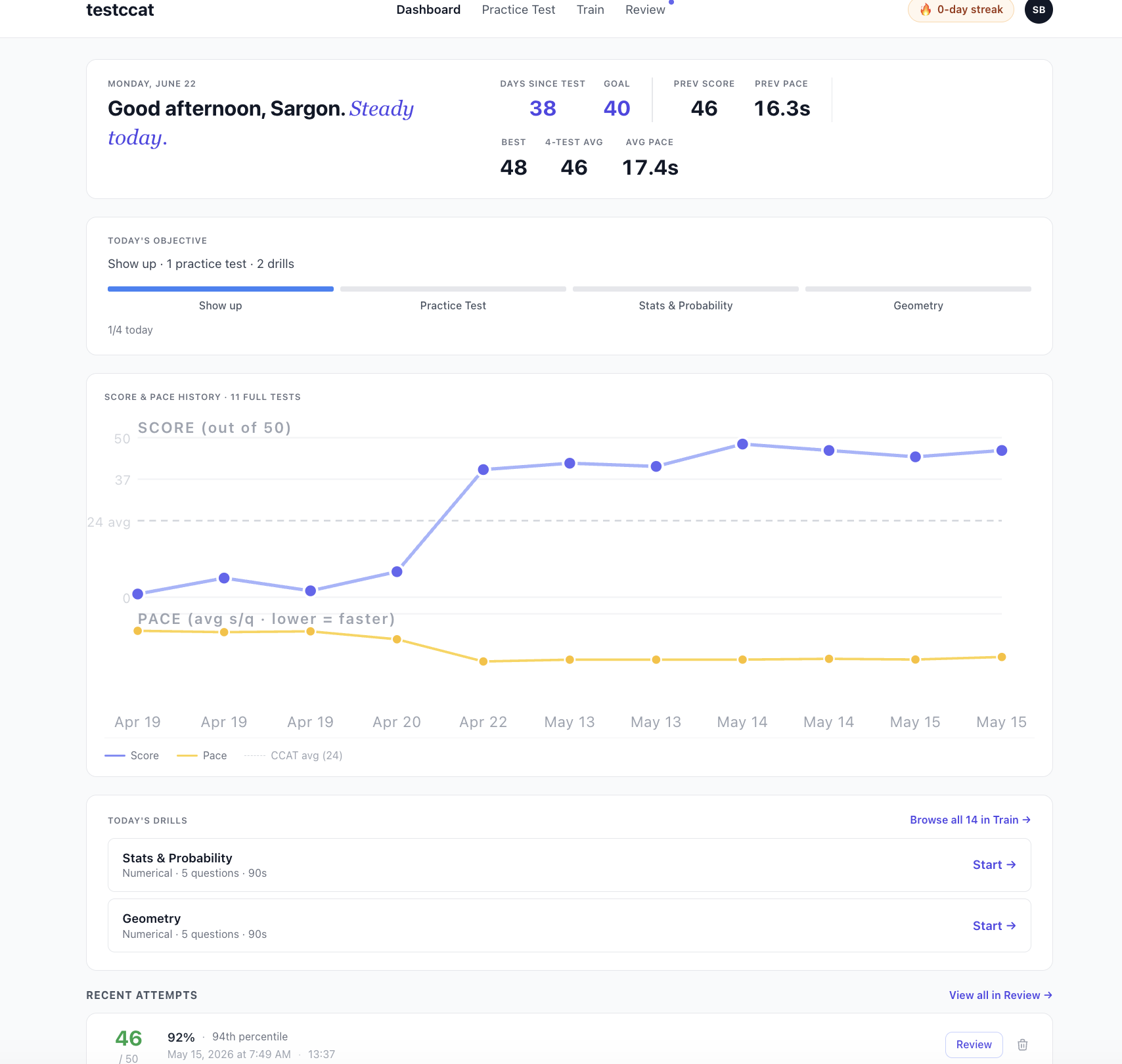
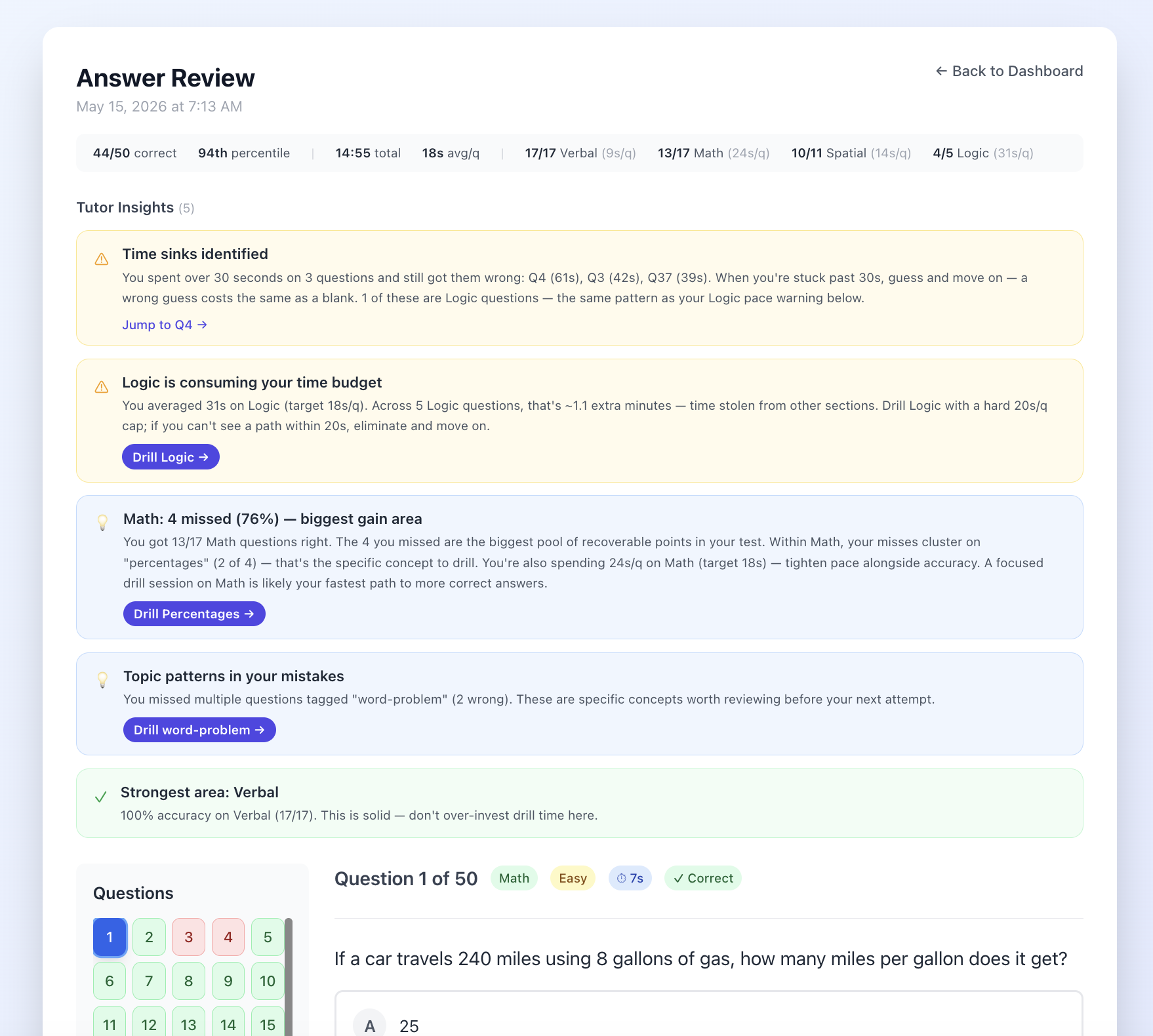
After every test, TestCCAT doesn't just hand you a number. It hands you a diagnosis. The dashboard reads your attempt like a tutor looking over your shoulder and surfaces patterns you'd never spot on your own.
It flags your time sinks, the questions where you spent extra seconds for no change in the outcome, so you learn where lingering actually costs you. It catches stamina decay, the accuracy drop in the second half of the test that tells you whether you're fading under the clock. It maps your category weaknesses so you know whether the problem is math, verbal, or spatial. And it shows pace versus accuracy, the central CCAT tradeoff: are you rushing into errors, or being so careful you're leaving questions unanswered?
2. Drills that target one skill at a time
Full tests measure you; drills improve you. TestCCAT breaks the exam into more than 20 subcategories (Math has Ratios & Fractions, Verbal has Analogies, Spatial has Next in Series) and lets you attack one at a time in focused 90-second bursts. At roughly 18 seconds per question, the pace matches the real test, so you're training speed and skill together instead of separately. For me the culprit was math work-rate problems; isolating that one subcategory did more for my score than another full-length test ever could.
The drills are smart about what they show you, too. Questions you answer correctly recycle out of the pool, so you spend your reps on the material you haven't mastered yet, not on questions you already nail. The pool keeps narrowing toward your weak spots until you've cleared it. (Want the full breakdown of categories? It's in the exam prep guides.)
One drill deserves its own mention: the Pacing Drill. It deliberately mixes question types and puts a hard 18-second clock on every single question. When the clock hits zero, the question is gone and the next one is already on screen. There is a Skip button, and using it is the point. The drill trains the decide-or-move reflex, the guess-and-go discipline that separates people who see all 50 questions from people who stall out at 35. Single-skill drills fix what you know; the Pacing Drill fixes how you behave when you don't. No other prep tool I reviewed trains the skip decision at all. You can try the free five-question Pacing Drill without signing up.
3. Mistakes review built on learning science
Here's where most prep falls apart, and where TestCCAT is built differently. Every question you miss or skip goes into a review queue. But it doesn't leave the queue the moment you get it right once, because answering correctly on a single day mostly proves you have short-term recall, not durable mastery.
Instead, a question only retires after you answer it correctly on three separate days. That spacing is deliberate: spaced retrieval forces your brain to reconstruct the answer after it's had time to forget, which is exactly the effort that converts a one-time fluke into long-term retention. It's the opposite of cramming.
Getting it right once is luck. Getting it right on three different days is learning.
4. Practice for the integrity check, not just the questions
Real CCAT proctoring watches more than your answers. It watches your behavior: tab switches, focus loss, suspicious timing, any of which can flag your result. Most prep sites pretend this layer doesn't exist, which means test day is the first time you ever feel that pressure.
TestCCAT surfaces the same integrity signals a real proctor watches, right inside practice. You learn what trips a flag and how to stay clean under observation, so the proctored environment feels familiar instead of nerve-wracking when it counts.
And it's not just me. I later cleared the proctored CCAT (the PCCAT) through Crossover, other GauntletAI challengers I know used TestCCAT to hit the bar, and premium users have since passed CCAT screens for engineering and product roles at the Australian Public Service, Automattic, and Crossover. Same approach every time: diagnose, drill, retain.
The bottom line
See the difference yourself
Take a full timed practice test free. No sign-up.
CCAT and Criteria are trademarks of Criteria Corp. TestCCAT is an independent study tool and is not affiliated with, authorized by, or endorsed by Criteria Corp, JobTestPrep, or 12minprep. Comparison reflects publicly available information as of June 2026; features and pricing may change.
More from the blog
Are You an NPC? I Built a 72-Second Brain Game to Settle It
Four questions, a hard 18-second clock, and a ghost replaying someone's exact answer times against you. The Cognitive Gauntlet is TestCCAT's free 72-second brain game, and it will judge you.
Why TestCCAT Makes You Retake Missed Questions on 3 Different Days
Full exams diagnose your weak spots. Tutor insights tell you what to drill. Mistakes review brings missed questions back until you answer them correctly across 3 separate days.
What the Proctored CCAT (PCCAT) Is Really Like: My 360° Room Scan, Phone Camera, and Activity Monitor Walkthrough
Webcam, a second phone camera on the Zoom call, a 360° room scan, and a slow screen-share through Activity Monitor. Exactly what a proctored CCAT looked like for me, so you're not surprised.
© 2026 TestCCAT · Last updated July 2026